One of the costliest mistakes you can make with your warehouse automation implementation has nothing to do with robotics or software.
The scenario is always the same, and we see it happen all too often: A facility invests millions in an advanced AS/RS, works through months of system design with integrators and engineers, and then they send a container spec to procurement.
Price. Lead time. Done.
The problem is that kind of commodity thinking almost always backfires. Leaving your automated packaging for the last minute, instead of engineering the right solution for your system from the start, is one of the most expensive mistakes warehouse operations can make.
Time to Rethink Your Packaging Perspective
The old warehouse model had a built-in error correction system: your people. A worker on the floor has no problem handling a container with a slightly bulging sidewall, a base that’s drifted a millimeter or two out of flat, or a barcode label that’s starting to lift at one corner. Human beings adapt. They compensate and then they move on. Problem solved.
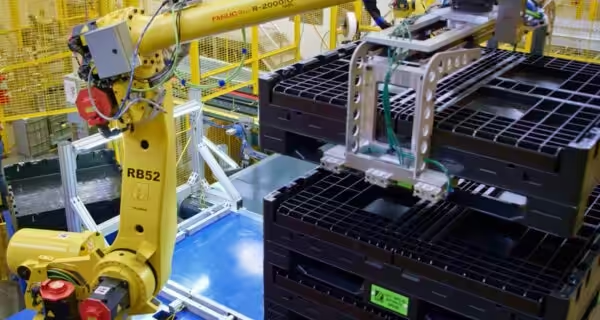
Automated systems aren’t nearly as flexible. Your AS/RS is calibrated to a precise specification. Anything outside of that specification is a fault condition. So that same sidewall bulge a human worker ignores without a second thought can disrupt conveyor guides, interfere with robotic gripping, or trigger a misread that stops the line. In a high-throughput operation, the downstream repercussions start to add up fast.
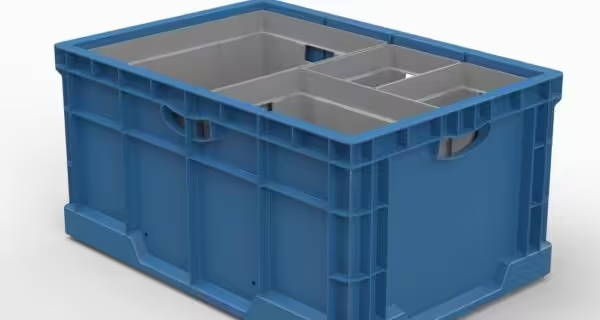
In an automated environment, your container isn’t just a simple product vessel. It’s a mechanical interface between technologies. A load-bearing system component. A data carrier. An uptime engine.
Your packaging is not a commodity. It’s essential infrastructure.
Four Factors Driving Automated Container Performance
As an essential element of your operational infrastructure, your containers are an engineering priority, not something to leave as a budget line item down the line. They should be built with the same design precision as the rest of your automated system. Talk with your integrator and engineering teams early and make sure you’re considering each of the following factors when designing your automated packaging:
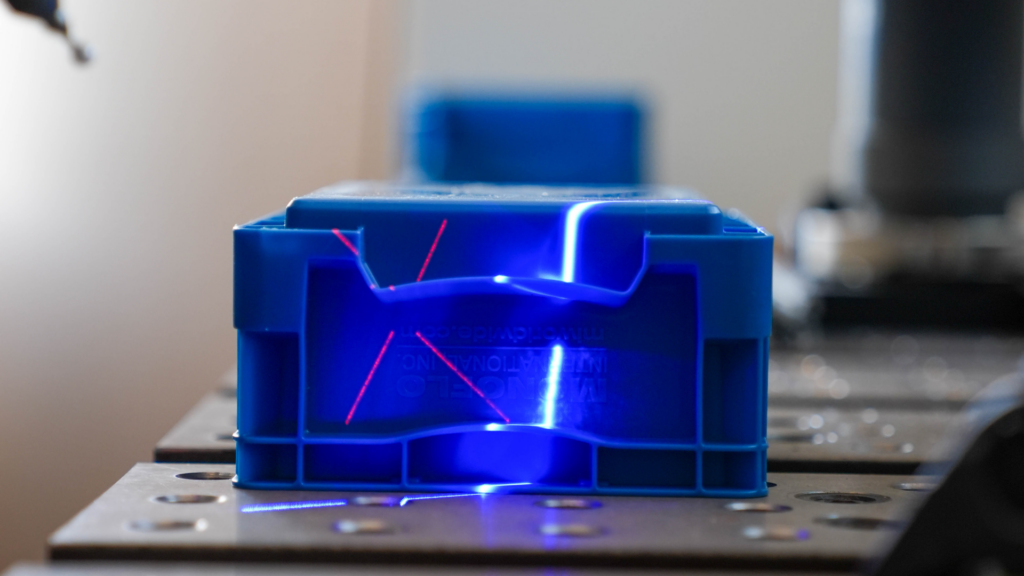
- Dimensional consistency: Automated systems are calibrated once and expected to run reliably across millions of cycles. That means every container needs to hold the same dimensions within millimeter tolerances… over the lifetime of your system. Variation between batches creates a calibration problem that shows up as sensor misreads, barcode alignment failures, and robotic handling errors.
- Base integrity: Containers moving through sortation environments have to divert at sharp angles across roller, skate-wheel, and belt conveyors. Any concavity or convexity in the base can lead to mishandling at the transition points. The right base design depends on the specific demands of the system. Load capacity, conveyance speed, rack storage requirements, and cleaning protocols are just a few of the variables to keep in mind when selecting the right base.
- Sidewall and structural performance: Balancing strength and cleanability is key in automated container design. Structural features like ribbing add rigidity, but they also create surfaces where debris and contaminants accumulate. Getting the balance right means understanding exactly where reinforcement is needed and where a clean, uninterrupted surface matters more.
- Scannability and traceability: Sortation sensors have milliseconds to make a read decision, so surface geometry in the scan zone must be clean and uninterrupted. Label adhesion methods matter here: a pulse-mold adhesive label expands and contracts at a different rate than the container substrate, which means lift, wrinkling, and misreads over time. In-mold labeling offers a more durable solution that will hold up across washdown cycles and high-cycle use.
The Container Design Conversation Starts Now
Warehouse automation projects absorb millions in capital investment. The containers that drive AS/RS performance need to be ready to roll when your system goes live. Considering the volumes most operations require, that doesn’t leave a very wide manufacturing window. Smaller systems might require 20,000 units, while a large-scale deployment might demand 200,000 to 300,000 containers. That kind of production takes time to fulfill and can only start once the engineering is locked in.
The operations that get it right bring their packaging partner into the design process early, as your system architecture is still being defined. That allows you to build your container specifications around the system’s mechanical realities rather than retrofitting them after the fact.
So if you’re planning a warehouse automation project, don’t wait to start talking containers with your engineers and integrators. The time for engineering your packaging solutions is now.
Ready to talk with an automated container expert? Monoflo’s team of warehouse automation packaging pros is standing by.