Our first post in this series made the case for running total cost of ownership (TCO) equations based on cost-per-cycle. In this second installment, we’re going to take a closer look at the costs that equation reveals. Especially when you’re comparing single-use and reusable packaging. Because once you move past unit price, the cost picture changes in ways that rarely show up on a purchase order.
The Shift From Consumable to Capital Asset
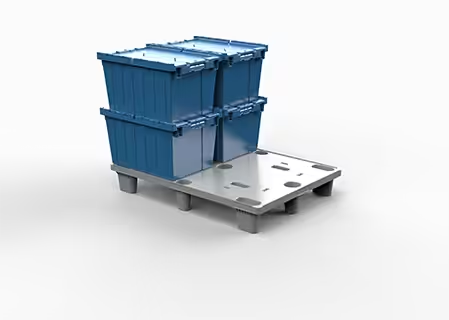
The most important reframe in any reusable container TCO analysis is categorical. Because corrugated is an operating expense: purchased, consumed, and replaced on a recurring cycle. A quality reusable container, on the other hand, is a capital asset. It’s designed to perform reliably and consistently over a defined service life. That essential distinction changes how cost is measured, evaluated, and ultimately: budgeted.
Most distribution operations that make the switch from corrugated capitalize their reusable container fleets over approximately six years. That estimated container life comes out to about 300–400 use cycles under normal operating conditions. At that cycle count, the per-unit value of reusable containers outpaces corrugated by a wide margin.
The Costs That Stack Up
That per-cycle cost comparison is a good starting point. But the full financial case for reusable containers goes much deeper. It builds through accumulation and a series of costs that might seem manageable in isolation but compound into a real operational expense when you put them together.
Start with the most obvious: repurchase cost. Single-use packaging is an expense that repeats every cycle without generating any long-term value. In high-velocity distribution operations processing thousands of picks per day, that recurring cost adds up fast.
Factor in the procurement overhead (sourcing, approvals, receiving, and reordering cycles) required for every repurchase, and the true administrative cost of that consumable model starts to come into focus.
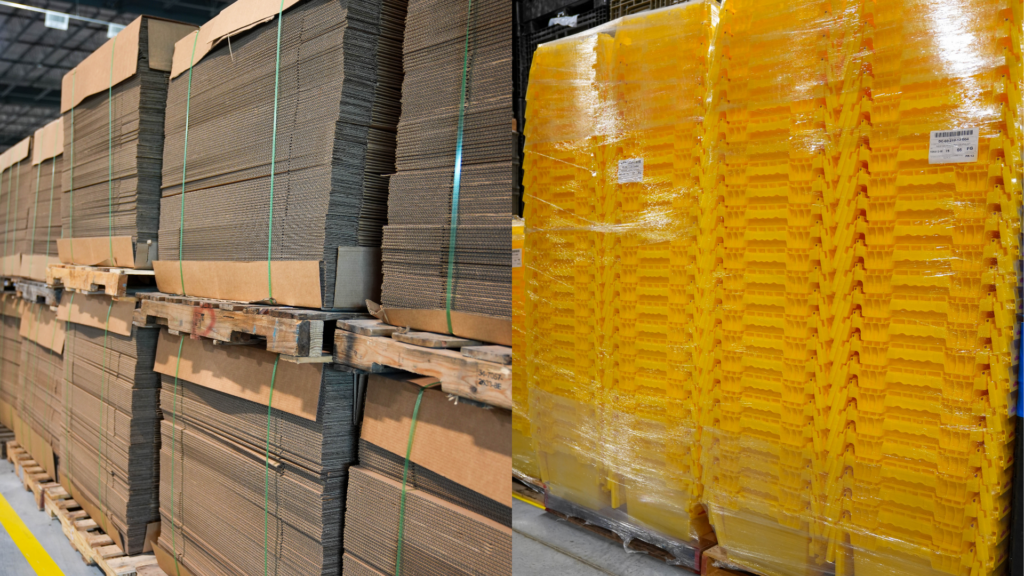
Next, let’s look at a cost that most analyses miss entirely: the inventory buffer. Operations running single-use packaging need to maintain on-hand reserves to guard against supply disruptions. That might mean entire trailer loads staged and taking up space in your warehouse. A reusable container fleet in active circulation doesn’t require that buffer because the containers are already in the supply chain, doing the work.
Speaking of your supply chain, corrugated pricing and availability can be unpredictable. It’s driven by wood pulp costs, freight surcharges, labor market conditions, and broader supply chain factors beyond any procurement team’s control. A reusable container fleet eliminates that risk exposure entirely.
Product Protection and Supply Chain Risk
The structural vulnerabilities of consumable packaging show up clearly under real operating conditions. In split-case picking environments, workers load outbound totes for last-mile delivery. Mixed product, varying fill levels, manual handling… This is where corrugated earns its reputation for inconsistency. A partially filled corrugated container offers a fraction of the structural support, and that vulnerability only compounds across hundreds of miles of in-transit vibration and impact.
When corrugated packaging fails in transit, the product usually arrives damaged and unsellable. In wholesale distribution, that triggers a credit dispute, a reorder cycle, and a customer service conversation nobody wants to have. But even worse, those downstream costs never connect back to the original packaging decision, so they never show up in the per-unit price comparison.
Security compounds container risk exposure even further. For operations handling high-value items (pharmaceuticals, wine, tobacco, DEA-controlled products) chain-of-custody integrity is non-negotiable. A properly secured reusable tote provides tamper evidence that corrugated simply can’t. If your tote has been opened, you’ll know. A re-taped corrugated box offers no such assurance, leaving loss prevention teams chasing a problem that better packaging would have prevented.
Sustainability as Value Confirmation
The environmental case for reusable packaging follows naturally from the operational advantages. When it comes to reusable container engineering, sustainability isn’t a program or a pledge. It’s a real product feature to be optimized at the design level. For instance, engineering decisions that reduce material weight per container add up, cycle after cycle, into meaningful freight and resource cost reductions.
Then there’s the recycling advantage. Eliminating corrugated from your distribution operation removes recurring waste stream expenses (disposal fees, baling logistics, etc.) and the carbon footprint of single-use material production, cycle after cycle. And just like their corrugated counterparts, reusable containers at the end of their service life can re-enter production as recycled content, closing the material loop entirely.
Increasingly in today’s logistics landscape, sustainability isn’t optional. Many downstream retail and food service partners are mandating the switch to reusable containers, making sustainability a supply chain compliance issue as much as a cost-saving initiative.
The (Limited) Case for Single-Use Containers
Full disclosure: reusable packaging isn’t right for every operation. Extended “milk-run” routes and open-loop supply chains without a reliable container return path make fleet attrition a real financial risk that erode the TCO advantage fast. For operations facing those constraints, container pooling models are emerging as an alternative. That approach converts the capital investment into a managed service that removes the closed-loop requirement.
But for closed-loop, high-velocity distribution operations, the math is clear. In high-turn environments, reusable container fleets can recoup their cost in as little as six months. Every cycle after that runs at a fraction of the cost of a single-use alternative without the procurement volatility, product-damage exposure, or supply chain dependency that come with it.
Closing the Container TCO Loop
The operations that win on container cost aren’t the ones that negotiated the lowest unit price. They’re the ones that reframed the procurement question entirely. Because the real question was never how much the container costs to purchase. It’s what that container you purchase costs your operation to own.
Considering the switch from consumable to reusable containers? Talk with one of our container design experts today.