
Sustainability commitments and automation investments are reshaping supply chains across Europe. The packaging running through those systems has to keep pace with both of these innovating forces.
Join us at Empack Gent, September 22–23 at Flanders Expo in Ghent — Stand #1021, where we’ll be showcasing reusable packaging built to balance these critical industry priorities:
- Automation Containers & Trays — precision-built for AS/RS, conveyor, and robotic handling integration
- Foldable Stack-Only (FSO) Containers — a 4:1 collapse ratio reduces freight costs and reclaims space without compromising structural performance
- Attached-Lid Totes — reliable, secure, and built for the cycle demands of high-volume fulfillment
- Reprocessing & Sustainability Programs — closed-loop container recovery designed to support circular supply chain commitments
Stand #1021 | Flanders Expo, Ghent, Belgium | September 22–23, 2026
How precision-engineered bins and production schedules helped Rogers Sporting Goods Scale fulfilment with AutoStore automation.
Rogers Sporting Goods is a family-owned operation specializing in waterfowl, hunting, shooting, and outdoor gear. Rapid growth and SKU expansion were pushing the limits of their Kansas City distribution center. They needed to update their omnichannel sporting goods warehousing and distribution model from the ground up to meet rising e-commerce demand. That meant accelerating order fulfillment turnaround times and increasing storage density.
There was just one catch: they had to scale without expanding their building footprint.
The Challenge: Hitting the Automation Bullseye
To support continued growth, Rogers Sporting Goods implemented a goods-to-person warehouse automation approach to increase storage density and reduce the labor required to retrieve inventory efficiently. Built around the AutoStore cube system and integrated by KPI Solutions, their solution consisted of 35 robots, five work ports, and 52,000 storage bins.
In highly automated warehouse environments like this one, every single bin is integral to the precision-driven system’s performance. Even the smallest deviations can cause bins to be rejected during validation and intake. In order to work seamlessly and continuously with the AutoStore robots, bin durability and dimensional tolerance were critical.
The Solution: On-Target Infrastructure in Every Bin
When it came to supplying the 52,000 AutoStore bins for this new system, KPI Solutions turned to Monoflo International. Over the years, Monoflo has worked extensively with KPI on a wide range of system implementations. Our proven track record as a best-in-class AutoStore bin manufacturer offered assurance that we could handle the job. But it wasn’t just the fact that we’ve achieved AutoStore recognition for industry-leading bin reject rates that made us the perfect fit for this project. Our reputation for outstanding service and flexibility also played a role.
Since Rogers Sporting Goods was implementing an automated warehouse system in an existing facility, limited space presented a logistical challenge. Big automation projects like this one require tens of thousands of bins, but brownfield sites rarely have the extra room on hand to stage all of those containers at once. Working closely with the team at KPI Solutions, we built our entire manufacturing approach around a phased delivery that aligned with their installation.
By carefully coordinating our production and shipment schedules, we precisely timed each delivery to streamline system induction. This approach allowed Rogers Sporting Goods to install and populate the AutoStore grid without disrupting their ongoing operations.
Added Value: Improving Environmental Impact with Packaging and Logistics
In order to further streamline delivery and reduce waste, we used the Monoflo Returnable Packaging System (RPS).
All Bins were shipped on reusable plastic pallets that were collected and returned after delivery, at no charge to the customer or the integrator. Plus, Monoflo’s unique pallet design enables us to pack approximately 140 bins more than the competition into every truckload, further reducing transportation costs and environmental impact.
Results: Sporting Goods Fulfillment Success
Automation systems and integrators often take center stage in today’s warehouse transformation stories. But, at the end of the day, these systems are built around the bins they move.
With their new system in place and packed with precision-engineered bins from Monoflo, Rogers Sporting Goods achieved 24-hour ecommerce order turnaround and raised their retail replenishment rate by 50%, while improving inventory accuracy and labor productivity across the board.
When the 2026 MHI Annual Industry Report dropped last month at MODEX, we were eager to dig into the latest data. Like so many supply chain professionals, we look forward to this yearly pulse check on the health of our industry and the emerging trends and challenges we all face. This in-depth survey of more than 500 experts (60% VP-level or above) always offers a sharp, detailed, and data-backed map of where the logistics and distribution landscape is headed. This year was no different…with one glaring omission.
Where’s the Container?
The 2026 report, titled REWIRING THE FUTURE, A Supply Chain Playbook for Innovation, identifies AI and Automation/Robotics as the biggest industry disruptors and offers recommendations for navigating the industry’s most pressing challenges. The report is on target and insightful. There’s just one problem. Throughout this detailed 35-page document, the term “containers” appears exactly once. In passing. In a case study about sea freight.
Unfortunately, that oversight is nothing new. All too often, when considering the critical technologies that drive our industry, the physical layer of distribution innovation is missed, or worse, ignored. For many operations, the container is the variable quietly limiting their performance innovation returns. As we read through this year’s report, we couldn’t help but notice that every trend mentioned connects directly to containers. Here’s a closer look at the top three:
TREND 1: Workforce & Labor Dependency
The MHI survey found that talent and workforce challenges affect 90% of supply chain organizations. Nearly two-thirds rate it a major challenge, up 9 points from last year.1 That should come as no surprise, of course. Automation is on the rise in response to these challenges. That’s true.
But the fact is that automation only reduces labor dependence when the containers running through your system are engineered to meet and maintain critical performance specs. Dimensional variances, degraded bases, worn sidewalls…these might not trigger a system alert, but they will trigger human intervention and response.
Because when your automation containers fail (or just underperform) an employee gets pulled off the floor to clear a jam, reposition a container, or override a sensor misread. The container is the one labor variable that many operations still haven’t isolated. When it doesn’t meet performance expectations, neither does your automated system. Regardless of how advanced your software and robotics might be.
Monoflo automation containers are engineered to maintain dimensional consistency across their full cycle life. Because an automated system is only as labor-independent as the components it runs on.
TREND 2: Technology Adoption & Real-Time Data
This year’s report identifies RFID, the Internet of Things (IoT), and advanced analytics as among the top investments that operations across the industry are prioritizing. The driving force behind that innovation momentum is simple: real-time data is no longer a “nice-to-have”. It’s a strategic necessity. MHI goes so far as to call out legacy systems that can’t support real-time data as an immediate operational threat.
What’s the one thing that all those technologies have in common? If you guessed “the container”, you’re catching on to the theme of this post. Containers are the physical layer that all three of those technologies attach to or directly interact with. If your container degrades in a way that impacts label readability or sensor detection, it creates a data gap and introduces costly instabilities in the data infrastructure. In industries where container traceability is a must-have, it pays to spec these features at the container design phase.
From smart sensors to precision tracking, if your containers aren’t engineered to move frictionlessly through your advanced warehouse systems, then the whole system underperforms.
Monoflo’s in-mold labeling (IML) capabilities and RFID-ready container designs are engineered to maintain identification integrity across high-cycle use, temperature variability, and washdown processes, so your traceability infrastructure performs as intended from first cycle to last.
TREND 3: eCommerce Growth & Fulfillment Speed
First, eCommerce changed the way the world shops. Then it changed the way the world ships. Along the way, customer expectations shifted. Now, next-day (if not same-day) delivery is becoming the norm. But the infrastructure that made those experiences and expectations possible is still being built through the rapid deployment of robotic picking, automated sortation, and high-speed conveyor systems across warehouses and distribution centers.
Those systems are engineered to tolerances measured in millimeters. If your containers don’t hold their dimensions, throughput variability compounds at scale. And when failures occur, they show up as fulfillment problems, not container problems. The actual root cause could end up costing your operation in the long run.
Monoflo containers are specified for high-speed automated sortation and picking environments. They’re engineered to the dimensional standards each unique system requires and proven to perform consistently across the cycle volumes those environments demand.
Connecting Container Innovation to Your Operation
Once again, this year’s MHI annual report clearly maps the strategic landscape of our rapidly evolving industry. But it misses the physical foundation that connects so many of the innovative technologies shaping the market.
Monoflo International has been perfecting that foundation for more than 50 years. We start at the system design stage, engineering containers to meet your operation’s unique needs. And our job’s not done until every single one of those containers is moving smoothly through every rack, conveyor, and sensor array.
At Automate, the floor is always packed with innovation. From advanced robots and scanning systems to the latest AI breakthroughs, this show is full of things that weren’t possible five years ago. But what about the containers moving through those systems? Don’t let the latest advances in automation container design pass your operation by…
Join us at Automate 2026, June 22–25 in Chicago. We’ll be at Booth #4404, where we’re showcasing:
- Foldable Stack-Only (FSO) Containers — 4:1 collapse ratio cuts freight costs and reclaims buffer zone space
- Dual Base Stack-Only Containers — engineered with angled rib geometry for superior strength and load stability
- Automation Containers & Trays— dimensionally consistent to the tolerances AS/RS, conveyor, and robotic systems require
- AutoStore® bins — designed for load durability and repeatability in high-density cube storage
If your containers aren’t advancing alongside your systems, let’s talk. Our team will be standing by at the booth to discuss your automation packaging needs and answer any questions.
Booth #4404 | McCormick Place, Chicago | June 22–25, 2026
Plan your visit to Automate 2026
One of the costliest mistakes you can make with your warehouse automation implementation has nothing to do with robotics or software.
The scenario is always the same, and we see it happen all too often: A facility invests millions in an advanced AS/RS, works through months of system design with integrators and engineers, and then they send a container spec to procurement.
Price. Lead time. Done.
The problem is that kind of commodity thinking almost always backfires. Leaving your automated packaging for the last minute, instead of engineering the right solution for your system from the start, is one of the most expensive mistakes warehouse operations can make.
Time to Rethink Your Packaging Perspective
The old warehouse model had a built-in error correction system: your people. A worker on the floor has no problem handling a container with a slightly bulging sidewall, a base that’s drifted a millimeter or two out of flat, or a barcode label that’s starting to lift at one corner. Human beings adapt. They compensate and then they move on. Problem solved.
Automated systems aren’t nearly as flexible. Your AS/RS is calibrated to a precise specification. Anything outside of that specification is a fault condition. So that same sidewall bulge a human worker ignores without a second thought can disrupt conveyor guides, interfere with robotic gripping, or trigger a misread that stops the line. In a high-throughput operation, the downstream repercussions start to add up fast.
In an automated environment, your container isn’t just a simple product vessel. It’s a mechanical interface between technologies. A load-bearing system component. A data carrier. An uptime engine.
Your packaging is not a commodity. It’s essential infrastructure.
Four Factors Driving Automated Container Performance
As an essential element of your operational infrastructure, your containers are an engineering priority, not something to leave as a budget line item down the line. They should be built with the same design precision as the rest of your automated system. Talk with your integrator and engineering teams early and make sure you’re considering each of the following factors when designing your automated packaging:
- Dimensional consistency: Automated systems are calibrated once and expected to run reliably across millions of cycles. That means every container needs to hold the same dimensions within millimeter tolerances… over the lifetime of your system. Variation between batches creates a calibration problem that shows up as sensor misreads, barcode alignment failures, and robotic handling errors.
- Base integrity: Containers moving through sortation environments have to divert at sharp angles across roller, skate-wheel, and belt conveyors. Any concavity or convexity in the base can lead to mishandling at the transition points. The right base design depends on the specific demands of the system. Load capacity, conveyance speed, rack storage requirements, and cleaning protocols are just a few of the variables to keep in mind when selecting the right base.
- Sidewall and structural performance: Balancing strength and cleanability is key in automated container design. Structural features like ribbing add rigidity, but they also create surfaces where debris and contaminants accumulate. Getting the balance right means understanding exactly where reinforcement is needed and where a clean, uninterrupted surface matters more.
- Scannability and traceability: Sortation sensors have milliseconds to make a read decision, so surface geometry in the scan zone must be clean and uninterrupted. Label adhesion methods matter here: a pulse-mold adhesive label expands and contracts at a different rate than the container substrate, which means lift, wrinkling, and misreads over time. In-mold labeling offers a more durable solution that will hold up across washdown cycles and high-cycle use.
The Container Design Conversation Starts Now
Warehouse automation projects absorb millions in capital investment. The containers that drive AS/RS performance need to be ready to roll when your system goes live. Considering the volumes most operations require, that doesn’t leave a very wide manufacturing window. Smaller systems might require 20,000 units, while a large-scale deployment might demand 200,000 to 300,000 containers. That kind of production takes time to fulfill and can only start once the engineering is locked in.
The operations that get it right bring their packaging partner into the design process early, as your system architecture is still being defined. That allows you to build your container specifications around the system’s mechanical realities rather than retrofitting them after the fact.
So if you’re planning a warehouse automation project, don’t wait to start talking containers with your engineers and integrators. The time for engineering your packaging solutions is now.
Ready to talk with an automated container expert? Monoflo’s team of warehouse automation packaging pros is standing by.
With the rapid rise of warehouse automation continuing to accelerate, distribution facilities face operational challenges ranging from the utilization of limited space to continuous system performance improvement. Containers are now a critical element of modern warehouse infrastructure.
Monoflo International recently announced the introduction of two new containers engineered to bring efficiency and durability to automated warehouse operations everyone: the Foldable Stack Only (FSO) container and Dual Base stack-only (SO) container. The new designs are scheduled for Q2 production and are already being specified on select projects.
“Automated storage and retrieval systems are evolving so fast,” says Dennis Williams, Monoflo’s Automation Group Director. “When it comes to packaging, we don’t want to just keep up. We’re setting the pace of innovation.”
Foldable Stack Only
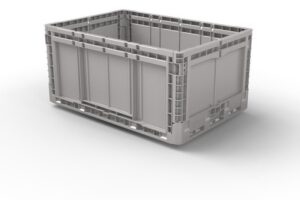
The Foldable Stack Only (FSO) is a collapsible container engineered to meet the demands of automated systems. Traditional collapsible containers have long offered logistical space-saving advantages but were often too weak, bulky, or unreliable to perform efficiently in high-throughput automation environments.
The Monoflo FSO line delivers the strength and reliability of traditional stack-only containers while unlocking space and freight savings. With a 4:1 storage ratio, the FSO offers up to a 75% freight reduction and requires a smaller storage footprint for space-constrained facilities.
Dual Base Stack-Only

Monoflo also introduced its new Dual Base stack-only container, a one-piece injection-molded design engineered for automation-driven warehouse environments. The Dual Base design balances welded-base strength with manufacturing efficiency.
Building on spider-base container designs widely used in European logistics systems, the container features smooth interior and exterior surfaces ideal for fresh food and sanitation-sensitive automation applications. The textured conveyance bottom and angled rib geometry are engineered to improve conveyance and reduce system noise in high-throughput operations.
Monoflo has decades of leadership in reusable transport packaging, including collapsible containers, automation-ready trays, and engineered solutions for high-velocity environments.
Foldable Stack-Only Automation Container 650x450x320 | Monoflo
Monoflo’s 650x450x320 mm Foldable Stack-Only Automation Container is the industry’s first collapsible solution engineered to work interchangeably with fixed-wall, stack-only containers. Designed to maximize flexibility and efficiency, it offers a 4:1 storage ratio, reducing freight costs by up to 75% and reclaiming valuable space in buffer zones — without sacrificing the strength and reliability of […]
Read More
Stack-Only Automation Container 600x400x320 Dual | Monoflo
The 600x400x320 mm Stack-Only Automation Container with dual base bottom delivers the structural performance of a welded-bottom container without added manufacturing complexity. Its one-piece, injection-molded construction is lighter than comparable welded designs and engineered for superior stiffness, load stability and strength-to-weight performance. Angled interior rib geometry in the base and a textured bottom improve conveyance […]
Read More
Monoflo International is proud to announce its participation in LogiMAT 2026, taking place March 24–26 at the Stuttgart Trade Fair Centre in Stuttgart, Germany.
Visit Team Monoflo in Hall 6, Stand 6C57, where we will be showcasing precision-engineered intralogistics packaging solutions designed to perform in automated storage, material handling, and high-throughput distribution environments.
At LogiMAT, Monoflo will feature a range of automation-ready and reusable solutions, including:
-
Automation containers, trays, and lifter plates designed for seamless integration with AS/RS, conveyor, and robotic handling systems
-
AutoStore™ bins engineered for durability, dimensional consistency, and reliable performance in high-density storage environments
-
Bulk collapsible and attached-lid distribution containers designed to improve cube efficiency, support closed-loop logistics, and perform reliably in high-cycle distribution operations
As North America’s leading supplier of reusable intralogistics packaging, Monoflo is excited to bring its newest solutions to the European market and connect with system integrators, OEMs, and logistics leaders from around the world.
We look forward to connecting in Stuttgart and demonstrating how Monoflo solutions are built to deliver more in automated and sustainable intralogistics applications.
Monoflo International will exhibit at Manifest 2026, taking place February 9–11, 2026, at the Venetian in Las Vegas, Nevada.
Visit Booth #2306 to see how Monoflo is built to deliver more for automated supply chains. Our team will showcase precision-engineered reusable packaging solutions designed to perform in today’s most demanding automation environments.
Featured solutions will include:
- Automation containers, trays, and lifter plates engineered for seamless integration with ASRS, conveyor, and robotic handling systems
- AutoStore bins designed for durability, consistency, and reliable performance in high-density automated storage applications
Stop by to connect with the Monoflo team and learn how our automation-ready solutions help customers move faster, operate more efficiently, and scale with confidence.
See you in Vegas.