As consumer expectations continue accelerating the pace of modern logistics, today’s automated warehouses are on a relentless quest to improve efficiency and throughput. One of the biggest challenges facing operators in that pursuit is the one-SKU-per-container model.
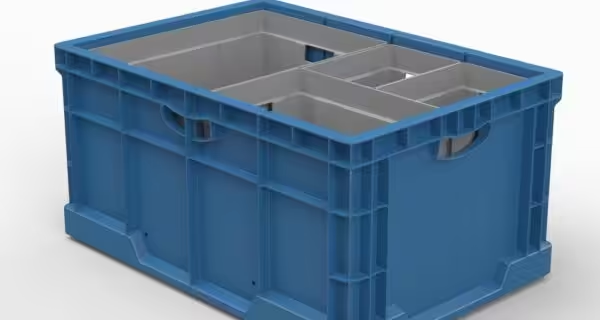
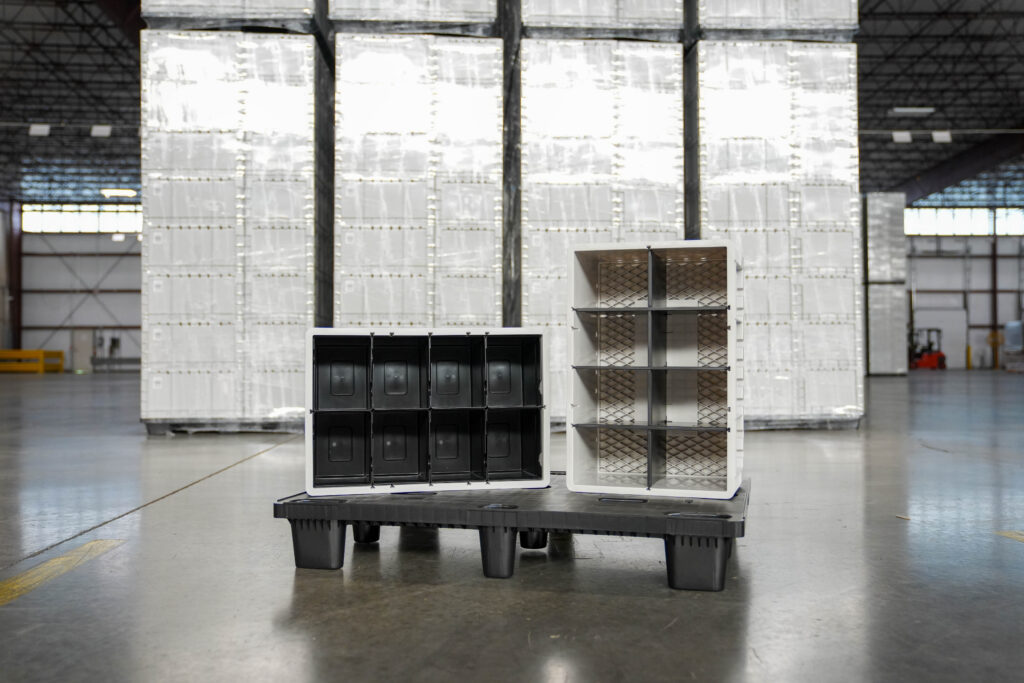
Monoflo meets that challenge and those escalating efficiency demands with our Mini-Tote System (MTS) and container dividers. The approach is simple: by subdividing a standard-footprint automation tote, you can increase storage density and the number of picks in each AS/RS cycle. But which solution you choose depends on your application and your operational demands. Here’s a quick overview of the options:

Automation Container Dividers
Monoflo container dividers compartmentalize the original tote footprint. The SKUs remain inside the captive container, making dividers the ideal solution for pick-and-pack or distribution operations, where operators can pick multiple SKUs from a single tote.
Durability is key here, because the cost of a failed divider is a lot higher than its replacement. A broken divider allows SKUs that were supposed to stay separate to mix within the container. That kind of failure creates a cross-contamination risk that leads to mispicks and, in the worst case, an inventory reconciliation problem.
Monoflo dividers are composed of solid polypropylene to withstand the wear and tear of daily AS/RS operations. Compared to competitor alternatives you commonly find on the market (fluted plastic and wood-pulp composite blends), Monoflo dividers deliver significantly more cycles without cracking or losing rigidity. In fact, Monoflo dividers are engineered to last the entire lifetime of the system, while operators typically have to replace cheaper alternatives every 18-24 months.
Monoflo container dividers work well for most SKUs in a pick-and-pack operation, but tote size and shape can create some limitations. It’s also important to consider the size of your SKUs when choosing the right solution for your operation. Very small or thin items (e.g., jewelry components or small hardware) can slide beneath a divider as the container moves through the system. When a facility regularly handles SKUs at that scale, the Mini-Tote System offers a more secure alternative.
Mini-Tote System (MTS)
The Monoflo MTS nests snugly into larger containers but can be easily removed for independent travel. This turns each sub-compartment within the container into a standalone handling unit, making MTS the ideal solution for manufacturing, assembly, and production-line operations.
Because MTS totes function as their own unit, they can move with an order or a work step instead of staying locked inside a single container. That flexibility opens up applications that a fixed divider configuration can’t reach. With MTS, operators can size and place units to match a specific production process, rather than a fixed set of compartments.
A customer of ours recently started using the Monoflo Mini-Tote System to improve efficiency at their aerospace engine plant. The facility’s AS/RS stores components in standard-footprint totes fitted with mini-totes. When a work order calls for a specific set of bolts, nuts, or washers for the next assembly step, the mini-tote holding that exact kit comes out of the system and travels directly to the production line, functioning like a pre-assembled kit.
MTS isn’t limited to manufacturing floors, though. Distribution and fulfillment operations use MTS too. Especially when they need the flexibility of a sub-compartment without the constraint of a fixed divider layout.
And for those small, thin SKUs that can slip beneath a divider? The Mini-Tote System solves that problem. Each SKU stays fully contained within its own compartment, whether it’s traveling through the AS/RS or moving out to the production floor.
Decanting: Where Dividers and MTS Meet
Monoflo mini-totes and dividers solve the same underlying SKU efficiency problem in slightly different ways. But they both depend on the same essential process to get products into the system in the first place: decanting.
Decanting is the process of breaking down manufacturer-packaged lots, pallets, cases, or bulk shipments into individual SKU-level units and loading them into AS/RS containers. This is the step that turns a pallet of a single product into hundreds of individually retrievable units.
Incoming product moves through an imaging and measurement process that captures dimensions, count, and weight. The warehouse management system (WMS) uses that data to determine exactly how a given SKU needs to be stored for efficient retrieval: whether that’s a full tote, a divided tote, or a mini-tote. Based on your decanting strategy and decision logic, the system then routes product to whichever automation container configuration fits best.
Ready to Solve the One-SKU-Per-Container Problem?
Every automated warehousing and distribution operation handles a different mix of SKUs, order profiles, and production requirements. Our team can help you determine whether dividers, MTS, or a combination of both is right for your operation.