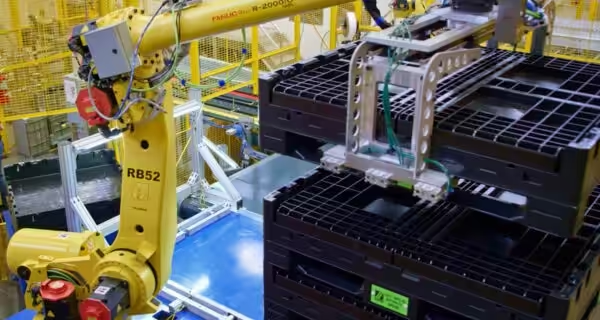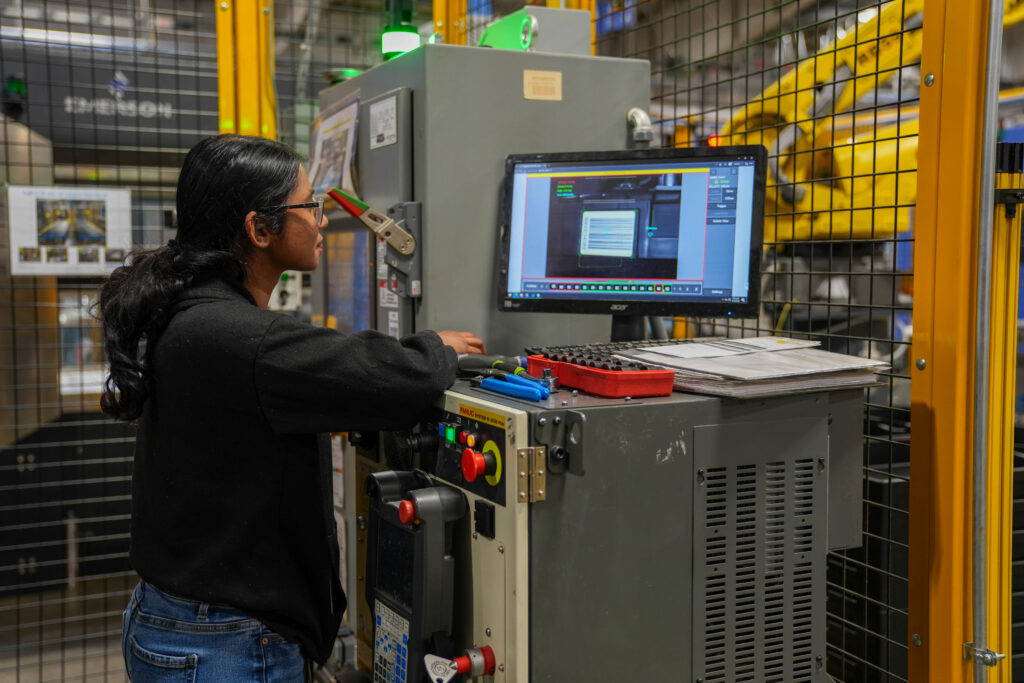
Modern automated distribution environments are built around a simple, but essential, operating requirement: every container moving through the system has to be reliably identified, every single cycle. When a label peels at a conveyor transfer point or a barcode can’t be read due to impact damage, everything stalls.
When that happens, the problem (usually) isn’t with the automated system. It’s with the container: the identification method wasn’t designed to survive its daily working conditions.
The underlying challenge here is that applied labels (pressure-sensitive barcodes or adhesive RFID tags mounted post-production) are consumable commodities attached to operational infrastructure.
These consumable labels degrade under repeated washdown cycles, temperature fluctuations, physical wear, and contact forces from high-cycle automation. That means misreads, missed scans, manual interventions, and, in the worst-case scenario, compromised traceability during a food safety event.
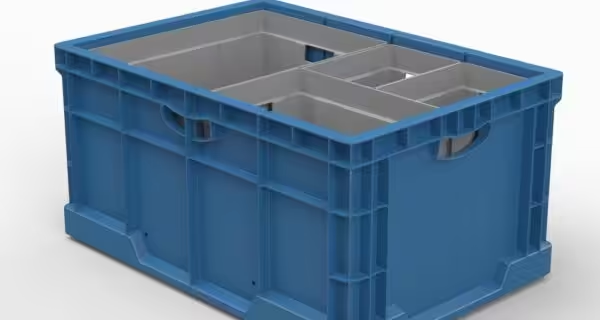
Monoflo automation containers and trays are available with two alternate identification options engineered to address this problem at the source.
1. RFID Smart Labels: Automated Identification Without Line-of-Sight
Traditional barcode scanning requires precise and consistent orientation. The label has to face the scanner, and the scanner has to see it. In high-speed sortation and AS/RS environments, operational costs increase with every misaligned container or obscured label.
But there’s another way.
RFID technology uses radio waves to transfer data encoded in a tag to a reader, enabling frictionless, automated identification without manual scanning or precise sensor alignment. For high-cycle automated warehouse operations, the advantages are clear:
- No line-of-sight required — containers are identified regardless of orientation or position on the conveyor
- Bulk identification — entire pallets or container groups scanned simultaneously, not one at a time
- Live inventory visibility — every container tracked from inbound receipt through outbound dispatch
- WMS integration — RFID tags connect directly to your warehouse management system for real-time stock control across inbound and outbound operations
Monoflo containers and trays are available with RFID Smart Labels as a factory-configured option across the entire automation product line. This means your identification infrastructure is specified during the container design phase, not as a post-deployment afterthought.
If traceability, recall readiness, or WMS-level inventory visibility is essential to your business, RFID containers are a game-changer. Talk with one of our container experts to find the right container identification for your operation.
2. In-Mold Labeling: Identification Built into the Container
Where RFID addresses the underlying technology, In-Mold Labeling (IML) addresses the durability of automated container and tray identification. The two are not mutually exclusive, and in many demanding warehouse environments, they’re often complementary.
IML is a manufacturing process in which a pre-printed label film is placed inside the injection mold before the plastic is formed. The heat and pressure of the molding process fuse the label permanently into the container wall. The result is a fixed design element with excellent impact and scratch resistance.
Standard applied labels face three common failure modes in today’s warehousing and distribution environments:
- Delamination from repeated temperature cycling
- Adhesive degradation from industrial washdown cycles
- Physical wear from conveyor contact and robotic handling
IML eliminates all three of these critical issues. Labels are fused within the container wall, so there are no adhesives to fail at sub-zero temperatures, no surface to delaminate under washdown, no edges to catch on a conveyor guide.
For operations that depend on reliable container and tray identification through hundreds or thousands of use cycles, IML removes this critical point of failure and eliminates a costly recurring maintenance issue.
RFID and IML Identification Comparison
| RFID Smart Labels | In-Mold Labeling | |
| Best for | Real-time tracking, WMS integration, high-speed automated environments | Washdown environments, temperature cycling, long-cycle durability |
| Key advantage | No line-of-sight scanning; bulk identification of containers and pallets | Identification fused permanently into the container wall |
| Typical environments | AS/RS, sortation, high-velocity distribution | Food & grocery, cold chain, industrial washdown |
| Validation | Validated at time of manufacture | Validated at time of manufacture |
| Available on | Monoflo automation containers & trays | Monoflo automation containers & trays |
Ready to Specify the Right Container Identification Solution for Your Operation?
Every automated warehousing and distribution operation has different requirements. Our team will help you determine which identification option (RFID, IML, or both) is right for your system, your cleaning protocols, and your WMS.