
El nearshoring está transformando la manufactura automotriz en Norteamérica. Los sistemas de empaque que transportan piezas entre proveedores, plantas y líneas de ensamblaje deben evolucionar en respuesta a estos cambios. Y establecer esta infraestructura correctamente desde el inicio es mucho más sencillo que corregirla bajo la presión de la producción.
Estaremos presentes en el Foro de Proveeduría Automotriz, los días 9 y 10 de septiembre en León, Guanajuato, en el Stand 424, presentando soluciones de empaque retornable diseñadas para satisfacer las exigencias de las cadenas de suministro automotrices a ambos lados de la frontera:
- Contenedores de paredes rectas (Straight-Wall Containers) — Aprobados por OEM, diseñados para proteger componentes de precisión en aplicaciones de alto ciclo desde el proveedor hasta la línea de producción.
- Tarimas (Pallets) — Fabricadas mediante moldeo por inyección para garantizar consistencia en la carga y compatibilidad con las instalaciones automotrices modernas.
- Contenedores plegables a granel (Bulk Collapsible Containers) — Diseñados para el movimiento de componentes sin los costos ni desperdicios asociados a las alternativas de un solo uso.
¿Está planeando un nuevo sistema de empaque o reconsiderando uno existente? Nuestro equipo estará disponible durante todo el evento para conversar sobre sus necesidades.
Stand 424 | Poliforum León, León, Guanajuato | 9–10 de septiembre de 2026
Planifique su visita a Automotriz 2026.
We’ll be at Foro de Proveeduría Automotriz, September 9–10 in León, Guanajuato — Booth 424 — with returnable packaging solutions built for the demands of automotive supply chains on both sides of the border:
Planning a new packaging system or rethinking an existing one? Our team will be on the floor.
Plan your visit to Automotriz 2026!
Our first post in this series made the case for running total cost of ownership (TCO) equations based on cost-per-cycle. In this second installment, we’re going to take a closer look at the costs that equation reveals. Especially when you’re comparing single-use and reusable packaging. Because once you move past unit price, the cost picture changes in ways that rarely show up on a purchase order.
The Shift From Consumable to Capital Asset
The most important reframe in any reusable container TCO analysis is categorical. Because corrugated is an operating expense: purchased, consumed, and replaced on a recurring cycle. A quality reusable container, on the other hand, is a capital asset. It’s designed to perform reliably and consistently over a defined service life. That essential distinction changes how cost is measured, evaluated, and ultimately: budgeted.
Most distribution operations that make the switch from corrugated capitalize their reusable container fleets over approximately six years. That estimated container life comes out to about 300–400 use cycles under normal operating conditions. At that cycle count, the per-unit value of reusable containers outpaces corrugated by a wide margin.
The Costs That Stack Up
That per-cycle cost comparison is a good starting point. But the full financial case for reusable containers goes much deeper. It builds through accumulation and a series of costs that might seem manageable in isolation but compound into a real operational expense when you put them together.
Start with the most obvious: repurchase cost. Single-use packaging is an expense that repeats every cycle without generating any long-term value. In high-velocity distribution operations processing thousands of picks per day, that recurring cost adds up fast.
Factor in the procurement overhead (sourcing, approvals, receiving, and reordering cycles) required for every repurchase, and the true administrative cost of that consumable model starts to come into focus.
Next, let’s look at a cost that most analyses miss entirely: the inventory buffer. Operations running single-use packaging need to maintain on-hand reserves to guard against supply disruptions. That might mean entire trailer loads staged and taking up space in your warehouse. A reusable container fleet in active circulation doesn’t require that buffer because the containers are already in the supply chain, doing the work.
Speaking of your supply chain, corrugated pricing and availability can be unpredictable. It’s driven by wood pulp costs, freight surcharges, labor market conditions, and broader supply chain factors beyond any procurement team’s control. A reusable container fleet eliminates that risk exposure entirely.
Product Protection and Supply Chain Risk
The structural vulnerabilities of consumable packaging show up clearly under real operating conditions. In split-case picking environments, workers load outbound totes for last-mile delivery. Mixed product, varying fill levels, manual handling… This is where corrugated earns its reputation for inconsistency. A partially filled corrugated container offers a fraction of the structural support, and that vulnerability only compounds across hundreds of miles of in-transit vibration and impact.
When corrugated packaging fails in transit, the product usually arrives damaged and unsellable. In wholesale distribution, that triggers a credit dispute, a reorder cycle, and a customer service conversation nobody wants to have. But even worse, those downstream costs never connect back to the original packaging decision, so they never show up in the per-unit price comparison.
Security compounds container risk exposure even further. For operations handling high-value items (pharmaceuticals, wine, tobacco, DEA-controlled products) chain-of-custody integrity is non-negotiable. A properly secured reusable tote provides tamper evidence that corrugated simply can’t. If your tote has been opened, you’ll know. A re-taped corrugated box offers no such assurance, leaving loss prevention teams chasing a problem that better packaging would have prevented.
Sustainability as Value Confirmation
The environmental case for reusable packaging follows naturally from the operational advantages. When it comes to reusable container engineering, sustainability isn’t a program or a pledge. It’s a real product feature to be optimized at the design level. For instance, engineering decisions that reduce material weight per container add up, cycle after cycle, into meaningful freight and resource cost reductions.
Then there’s the recycling advantage. Eliminating corrugated from your distribution operation removes recurring waste stream expenses (disposal fees, baling logistics, etc.) and the carbon footprint of single-use material production, cycle after cycle. And just like their corrugated counterparts, reusable containers at the end of their service life can re-enter production as recycled content, closing the material loop entirely.
Increasingly in today’s logistics landscape, sustainability isn’t optional. Many downstream retail and food service partners are mandating the switch to reusable containers, making sustainability a supply chain compliance issue as much as a cost-saving initiative.
The (Limited) Case for Single-Use Containers
Full disclosure: reusable packaging isn’t right for every operation. Extended “milk-run” routes and open-loop supply chains without a reliable container return path make fleet attrition a real financial risk that erode the TCO advantage fast. For operations facing those constraints, container pooling models are emerging as an alternative. That approach converts the capital investment into a managed service that removes the closed-loop requirement.
But for closed-loop, high-velocity distribution operations, the math is clear. In high-turn environments, reusable container fleets can recoup their cost in as little as six months. Every cycle after that runs at a fraction of the cost of a single-use alternative without the procurement volatility, product-damage exposure, or supply chain dependency that come with it.
Closing the Container TCO Loop
The operations that win on container cost aren’t the ones that negotiated the lowest unit price. They’re the ones that reframed the procurement question entirely. Because the real question was never how much the container costs to purchase. It’s what that container you purchase costs your operation to own.
Considering the switch from consumable to reusable containers? Talk with one of our container design experts today.
Procurement departments everywhere are under constant pressure to control costs and meet operational demands under ever-tightening budgets. So, it’s no surprise they all tend to operate on the same basic principle: fulfill the engineering spec for the lowest possible price…
But when it comes to your automated warehouse containers, it pays to focus on cost, not price.
If the spec is the same, why not select the cheapest option? The problem with that tried-and-true procurement equation is that product specifications on paper don’t always add up to real-world performance. So, while that lower-priced corrugated container might meet the engineering requirements at a glance, it’s likely to end up costing you much more in the long run.
Because price (the amount you pay once for each container) is much easier to calculate than cost, which includes everything the container requires over its entire working life: e.g. replacements, labor, system disruptions, and other key performance factors.
The Math Most Procurement Teams Miss
Unit Price ÷ Expected Cycle Life = Unit Cost
The basic equation isn’t the problem. When you take that first step beyond price and bring container lifecycle into the mix, the picture starts to shift. Run that number against lower-priced alternatives with shorter lifecycle projections, and the math usually flips. So why do so many procurement departments still purchase on price alone? The challenge is assembling the inputs from across multiple departments:
- Operations oversees cycle frequency & system downtime
- Maintenance owns repair rates & labor costs
- Logistics tracks return handling & buffer stock
- Finance handles depreciation & disposal
Procurement rarely owns any, let alone all of that. Pulling those numbers together means crossing organizational lines. That takes time and inter-department collaboration capital that many buyers don’t want to spend on a container decision. Combine that with tight project deadlines, and it’s easy to see why the TCO calculation so often gets skipped.
But for operations that invest the time, the returns are worth the effort. Because, as volume and cycle frequency increase, so do the cost savings. That makes durability one of the most critical variables in any TCO equation.
Defining Container Durability
Durability in a warehouse operation is essentially a measure of how long a container holds dimensional consistency, structural integrity under load, and stack performance over repeated cycles. These specs are especially important in automated environments where even the slightest variance can disrupt the entire operation.
Many procurement departments mistake those specs for a list of features. In reality, each one is an engineering decision that directly affects performance outcomes.
Dimensional Consistency: Automated systems are calibrated to precise container specifications with tolerances measured in millimeters, not inches. A container that holds its shape cycle after cycle keeps your system moving smoothly. One that doesn’t introduces variance your system wasn’t designed to absorb.
Structural Integrity Under Load: Distribution environments repeatedly stack containers under real weight, cycle after cycle, day after day. A container that maintains base rigidity and sidewall stability performs the same on cycle 5,000 as it did on cycle one. One that deflects or deforms under pressure doesn’t just wear out, it becomes unpredictable and likely to cause system disruptions.
Stack Performance Over Time: In high-cycle environments, consistent stack height is a system requirement. Structural fatigue that compresses stack height over time disrupts automated depalletizing, reduces storage density, and creates performance variability that cascades through downstream workflows.
Unlike a dimensional spec or a load rating, these performance characteristics aren’t easily evaluated at the time of purchase. They’re proven over thousands of cycles, under real operating conditions, throughout the container’s full working life.
That’s what makes them central to any TCO conversation — and easy to miss in standard procurement reviews. When evaluating container providers, be sure to ask about these long-term performance characteristics to get a better idea of the full lifecycle value of your purchase.
Stay tuned for Part 2 in this container TCO conversation, where we’ll look at the hidden costs of container degradation, from system downtime and replacement cycles to product damage and supply chain risk.
When the 2026 MHI Annual Industry Report dropped last month at MODEX, we were eager to dig into the latest data. Like so many supply chain professionals, we look forward to this yearly pulse check on the health of our industry and the emerging trends and challenges we all face. This in-depth survey of more than 500 experts (60% VP-level or above) always offers a sharp, detailed, and data-backed map of where the logistics and distribution landscape is headed. This year was no different…with one glaring omission.
Where’s the Container?
The 2026 report, titled REWIRING THE FUTURE, A Supply Chain Playbook for Innovation, identifies AI and Automation/Robotics as the biggest industry disruptors and offers recommendations for navigating the industry’s most pressing challenges. The report is on target and insightful. There’s just one problem. Throughout this detailed 35-page document, the term “containers” appears exactly once. In passing. In a case study about sea freight.
Unfortunately, that oversight is nothing new. All too often, when considering the critical technologies that drive our industry, the physical layer of distribution innovation is missed, or worse, ignored. For many operations, the container is the variable quietly limiting their performance innovation returns. As we read through this year’s report, we couldn’t help but notice that every trend mentioned connects directly to containers. Here’s a closer look at the top three:
TREND 1: Workforce & Labor Dependency
The MHI survey found that talent and workforce challenges affect 90% of supply chain organizations. Nearly two-thirds rate it a major challenge, up 9 points from last year.1 That should come as no surprise, of course. Automation is on the rise in response to these challenges. That’s true.
But the fact is that automation only reduces labor dependence when the containers running through your system are engineered to meet and maintain critical performance specs. Dimensional variances, degraded bases, worn sidewalls…these might not trigger a system alert, but they will trigger human intervention and response.
Because when your automation containers fail (or just underperform) an employee gets pulled off the floor to clear a jam, reposition a container, or override a sensor misread. The container is the one labor variable that many operations still haven’t isolated. When it doesn’t meet performance expectations, neither does your automated system. Regardless of how advanced your software and robotics might be.
Monoflo automation containers are engineered to maintain dimensional consistency across their full cycle life. Because an automated system is only as labor-independent as the components it runs on.
TREND 2: Technology Adoption & Real-Time Data
This year’s report identifies RFID, the Internet of Things (IoT), and advanced analytics as among the top investments that operations across the industry are prioritizing. The driving force behind that innovation momentum is simple: real-time data is no longer a “nice-to-have”. It’s a strategic necessity. MHI goes so far as to call out legacy systems that can’t support real-time data as an immediate operational threat.
What’s the one thing that all those technologies have in common? If you guessed “the container”, you’re catching on to the theme of this post. Containers are the physical layer that all three of those technologies attach to or directly interact with. If your container degrades in a way that impacts label readability or sensor detection, it creates a data gap and introduces costly instabilities in the data infrastructure. In industries where container traceability is a must-have, it pays to spec these features at the container design phase.
From smart sensors to precision tracking, if your containers aren’t engineered to move frictionlessly through your advanced warehouse systems, then the whole system underperforms.
Monoflo’s in-mold labeling (IML) capabilities and RFID-ready container designs are engineered to maintain identification integrity across high-cycle use, temperature variability, and washdown processes, so your traceability infrastructure performs as intended from first cycle to last.
TREND 3: eCommerce Growth & Fulfillment Speed
First, eCommerce changed the way the world shops. Then it changed the way the world ships. Along the way, customer expectations shifted. Now, next-day (if not same-day) delivery is becoming the norm. But the infrastructure that made those experiences and expectations possible is still being built through the rapid deployment of robotic picking, automated sortation, and high-speed conveyor systems across warehouses and distribution centers.
Those systems are engineered to tolerances measured in millimeters. If your containers don’t hold their dimensions, throughput variability compounds at scale. And when failures occur, they show up as fulfillment problems, not container problems. The actual root cause could end up costing your operation in the long run.
Monoflo containers are specified for high-speed automated sortation and picking environments. They’re engineered to the dimensional standards each unique system requires and proven to perform consistently across the cycle volumes those environments demand.
Connecting Container Innovation to Your Operation
Once again, this year’s MHI annual report clearly maps the strategic landscape of our rapidly evolving industry. But it misses the physical foundation that connects so many of the innovative technologies shaping the market.
Monoflo International has been perfecting that foundation for more than 50 years. We start at the system design stage, engineering containers to meet your operation’s unique needs. And our job’s not done until every single one of those containers is moving smoothly through every rack, conveyor, and sensor array.
At Automate, the floor is always packed with innovation. From advanced robots and scanning systems to the latest AI breakthroughs, this show is full of things that weren’t possible five years ago. But what about the containers moving through those systems? Don’t let the latest advances in automation container design pass your operation by…
Join us at Automate 2026, June 22–25 in Chicago. We’ll be at Booth #4404, where we’re showcasing:
- Foldable Stack-Only (FSO) Containers — 4:1 collapse ratio cuts freight costs and reclaims buffer zone space
- Dual Base Stack-Only Containers — engineered with angled rib geometry for superior strength and load stability
- Automation Containers & Trays— dimensionally consistent to the tolerances AS/RS, conveyor, and robotic systems require
- AutoStore® bins — designed for load durability and repeatability in high-density cube storage
If your containers aren’t advancing alongside your systems, let’s talk. Our team will be standing by at the booth to discuss your automation packaging needs and answer any questions.
Booth #4404 | McCormick Place, Chicago | June 22–25, 2026
Plan your visit to Automate 2026
With the rapid rise of warehouse automation continuing to accelerate, distribution facilities face operational challenges ranging from the utilization of limited space to continuous system performance improvement. Containers are now a critical element of modern warehouse infrastructure.
Monoflo International recently announced the introduction of two new containers engineered to bring efficiency and durability to automated warehouse operations everyone: the Foldable Stack Only (FSO) container and Dual Base stack-only (SO) container. The new designs are scheduled for Q2 production and are already being specified on select projects.
“Automated storage and retrieval systems are evolving so fast,” says Dennis Williams, Monoflo’s Automation Group Director. “When it comes to packaging, we don’t want to just keep up. We’re setting the pace of innovation.”
Foldable Stack Only
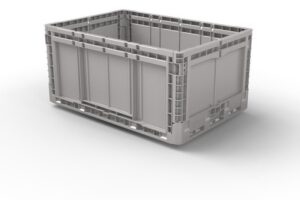
The Foldable Stack Only (FSO) is a collapsible container engineered to meet the demands of automated systems. Traditional collapsible containers have long offered logistical space-saving advantages but were often too weak, bulky, or unreliable to perform efficiently in high-throughput automation environments.
The Monoflo FSO line delivers the strength and reliability of traditional stack-only containers while unlocking space and freight savings. With a 4:1 storage ratio, the FSO offers up to a 75% freight reduction and requires a smaller storage footprint for space-constrained facilities.
Dual Base Stack-Only

Monoflo also introduced its new Dual Base stack-only container, a one-piece injection-molded design engineered for automation-driven warehouse environments. The Dual Base design balances welded-base strength with manufacturing efficiency.
Building on spider-base container designs widely used in European logistics systems, the container features smooth interior and exterior surfaces ideal for fresh food and sanitation-sensitive automation applications. The textured conveyance bottom and angled rib geometry are engineered to improve conveyance and reduce system noise in high-throughput operations.
Monoflo has decades of leadership in reusable transport packaging, including collapsible containers, automation-ready trays, and engineered solutions for high-velocity environments.
Foldable Stack-Only Automation Container 650x450x320 | Monoflo
Monoflo’s 650x450x320 mm Foldable Stack-Only Automation Container is the industry’s first collapsible solution engineered to work interchangeably with fixed-wall, stack-only containers. Designed to maximize flexibility and efficiency, it offers a 4:1 storage ratio, reducing freight costs by up to 75% and reclaiming valuable space in buffer zones — without sacrificing the strength and reliability of […]
Read More
Stack-Only Automation Container 600x400x320 Dual | Monoflo
The 600x400x320 mm Stack-Only Automation Container with dual base bottom delivers the structural performance of a welded-bottom container without added manufacturing complexity. Its one-piece, injection-molded construction is lighter than comparable welded designs and engineered for superior stiffness, load stability and strength-to-weight performance. Angled interior rib geometry in the base and a textured bottom improve conveyance […]
Read More
As the pace of warehouse automation accelerates, packaging becomes an essential element of your logistics infrastructure. Don’t let dimensional variances drag you into the downtime trap.
Join Monoflo International at MODEX, April 13-16 in Atlanta, GA. We’ll be showcasing some key automation innovations at Booth A3409, including:
- Automation containers & trays — dimensionally consistent to the tolerances AS/RS, conveyor, and robotic systems require
- AutoStore® bins — engineered for load durability and repeatability in high-density cube storage
- Collapsible bulk containers — built for closed-loop return logistics without throughput compromise
- Attached lid totes — designed for secure handling and consistent stacking across automated distribution and closed-loop delivery networks
- Straight wall containers — built for precise dimensions and reliable flow through conveyors, workstations, and automated manufacturing systems
- Plastic pallets — engineered for consistent dimensions, load stability, and reliable movement through automated storage, conveying, and distribution systems
Got an automated warehouse packaging challenge? Bring your spec along. Our team will be on site to help you find the right solution.
Booth A3409 | Georgia World Conference Center Atlanta | April 13-16
Winchester, VA (Feb. 10, 2026) – Monoflo International, Inc., an industry-leading supplier of reusable injection-molded packaging, recently launched a newly redesigned website that makes it quick and easy for users to find packaging solutions that maximize value in modern supply chains.
As warehouse and logistics needs change, the rise of connected, data-driven supply chains is creating demand for packaging that keeps pace with machine-led workflows and integrates with sensors, automation and inventory tracking. At the same time, e-commerce and rapid fulfillment models require totes, containers, trays and pallets that support consistent, high-throughput operations. To obtain the right packaging solutions when needed, companies require faster, simpler access to key information.
Monoflo’s new site features streamlined, intuitive navigation that helps users quickly discover products, explore detailed specifications and move efficiently toward purchase decisions. This user-centric experience better reflects the responsiveness and dedicated partnership that Monoflo is known for.
“Monoflo is recognized as a dependable, high-quality manufacturer that prioritizes both product excellence and customer satisfaction, a dual focus that is a cornerstone of our identity,” said Josh Albert, director of marketing, Monoflo. “The modern, visually compelling design of our new digital presence embodies this identity, reflecting our culture, innovation and commitment to relentless improvement: engineering smarter solutions and showing up with consistency where it matters most.”
To learn more about Monoflo and its precision-engineered injection-molded packaging systems, please visit https://miworldwide.com/.
About Monoflo International
Monoflo International designs, engineers and manufactures reusable injection-molded packaging, including totes, containers, trays and pallets, for some of the world’s most recognized brands. An industry-leading supplier of reusable packaging, Monoflo is distinguished by its commitment to building trusted partnerships that position customers for success. Guided by an excellence-obsessed mindset, a relentless focus on innovation and a people-centered approach to business, Monoflo delivers packaging solutions that help industries streamline supply chains, advance sustainability and achieve their goals with confidence.
For more information contact:
Josh Albert
Director of Marketing, Monoflo International
Tel: 540-771-3176
Monoflo International is proud to announce its participation in LogiMAT 2026, taking place March 24–26 at the Stuttgart Trade Fair Centre in Stuttgart, Germany.
Visit Team Monoflo in Hall 6, Stand 6C57, where we will be showcasing precision-engineered intralogistics packaging solutions designed to perform in automated storage, material handling, and high-throughput distribution environments.
At LogiMAT, Monoflo will feature a range of automation-ready and reusable solutions, including:
-
Automation containers, trays, and lifter plates designed for seamless integration with AS/RS, conveyor, and robotic handling systems
-
AutoStore™ bins engineered for durability, dimensional consistency, and reliable performance in high-density storage environments
-
Bulk collapsible and attached-lid distribution containers designed to improve cube efficiency, support closed-loop logistics, and perform reliably in high-cycle distribution operations
As North America’s leading supplier of reusable intralogistics packaging, Monoflo is excited to bring its newest solutions to the European market and connect with system integrators, OEMs, and logistics leaders from around the world.
We look forward to connecting in Stuttgart and demonstrating how Monoflo solutions are built to deliver more in automated and sustainable intralogistics applications.
Monoflo International will exhibit at Manifest 2026, taking place February 9–11, 2026, at the Venetian in Las Vegas, Nevada.
Visit Booth #2306 to see how Monoflo is built to deliver more for automated supply chains. Our team will showcase precision-engineered reusable packaging solutions designed to perform in today’s most demanding automation environments.
Featured solutions will include:
- Automation containers, trays, and lifter plates engineered for seamless integration with ASRS, conveyor, and robotic handling systems
- AutoStore bins designed for durability, consistency, and reliable performance in high-density automated storage applications
Stop by to connect with the Monoflo team and learn how our automation-ready solutions help customers move faster, operate more efficiently, and scale with confidence.
See you in Vegas.